
Would you know what to do if you witnessed warning signs of potential violent behavior? Would your child or student know what to do to prevent school violence?
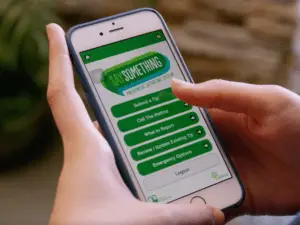
Empowered with the knowledge gained from the Say Something program and with access to the Say Something Anonymous Reporting System (Say Something ARS), students are recognizing the warning signs of violence and taking action to stop potential school shootings from happening.
Even One Tip, One Voice, Can Save Lives
In California (September 2025), a Say Something-informed student Upstander recognized the warning signs among a peer’s troubling Instagram posts. The alleged suspect had posted detailed threats on social media about committing a school shooting. The posts included images of ammunition and a mapped-out plan for attacking the school. This set off a swift chain of events.
The courageous Upstander took those threats seriously and immediately submitted their concern to Sandy Hook Promise’s National Crisis Center (NCC) via the Say Something ARS. The NCC’s crisis counselors triaged that single tip and worked closely with district partners and law enforcement officials to prevent a tragedy.
This incident was the 19th-verified planned school shooting that has been prevented by Sandy Hook Promise programs.
“Sometimes we receive hundreds of tips about a potential threat,” Nicole Hockley, CEO and co-founder of Sandy Hook Promise, said. “Other times, as we saw in California during this incident, it just takes one. At a time where many feel powerless against gun violence, this student’s bravery proves that each of us has the ability to make difference.”
Earlier in 2025, a 14-year-old suspect in Florida was arrested after more than 40 tips about threatening social media messages were submitted to the NCC through the Say Something ARS. The suspect was a student that had made threats online to commit a mass shooting at a school. Again, a community came together to “say something” and save lives.
Learn more about the many tragedies prevented and lives saved by the work of Sandy Hook Promise.
How ‘Say Something’ Works to Prevent School Violence
Gun violence is not inevitable – it is preventable – and prevention begins when we recognize the signs and take action.
Beatriz Ramirez works as a Supervisor in the NCC. Ultimately, she says that it’s the collaboration between Upstanders and Trusted Adults that makes the Say Something and Say Something ARS work so well for life-saving intervention. “It’s that support, training, and resources for the community,” Ramirez says. “And a focus on identifying key warning signs, acting immediately, and saying something. For us in the Crisis Center, every single tip is addressed as soon as we receive it and is taken seriously.”
Say Something training focuses on three primary steps:
1. Recognize the signs. Learn the warning signs of violence and threats and how to spot them, especially on social media.
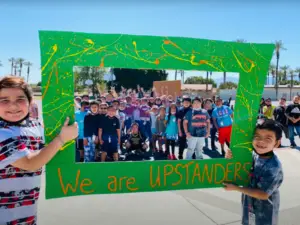
2. Act immediately; take it seriously. Lean into Upstander behavior with strategies to take action.
3. “Say something” to a Trusted Adult and / or submit a tip to the anonymous reporting system.
Jessica Neely is the Director of Sandy Hook Promise’s National Crisis Center. With an education background and having worked with students, she recognized the safety and mental health challenges her own students had faced within her district. “We have a robust system that teaches communities to be proactive and not reactive,” she says. “When school districts partner with us, they join a community of people who work and carry out the mission of making schools safer.”
How Policy Works to Prevent School Violence
The protection of children is paramount. The Sandy Hook Promise Action Fund works to pass legislation that advances school safety and mental health and prevents gun violence.
In 2018, Sandy Hook Promise helped write and pass the bipartisan Students, Teachers, and Officers Preventing (STOP) School Violence Act that allows school districts, municipalities, states, and tribal organizations to apply for funding that ensures budget is never a barrier to making schools safer.
Another one of those key pieces of legislation to keep children safe is the PLAN for School Safety Act of 2025. This helps schools cut through choice overload by funding state-based, expert-led School Safety Centers that give educators direct support on how to protect children from school shootings and other acts of violence.
“Bipartisan legislation like the PLAN for School Safety Act and the STOP School Violence Act provide critical resources and funding for proactive prevention, including training on warning signs and anonymous reporting systems,” Mark Barden, co-founder of Sandy Hook Promise says. “Federal policies like these are important elements that make interventions possible.”
Learn more about these policy solutions from the Sandy Hook Promise Action Fund.
How Trusted Adults Can Help
Whether you’re a parent, caregiver, educator, or caring adult in your community, your role as a Trusted Adult is more critical than ever to help prevent school violence.
Here’s how you can help provide a safer school community:
• Get tips for Trusted Adults.
• Know your school community’s safety plan. Sandy Hook Promise’s Guiding Principles of Threat Assessments outlines strategies for everyone in a school community to have the hard conversations.
• Sign the petition to stop gun marketers from advertising to kids. Learn more about UnTargeting Kids.
• Spread the Word! Raise awareness on social media with our action kit. Honor gun violence survivors with action and stand with us to #ProtectOurKids from gun violence.